System Security Plan

Your SSP, generated from live telemetry

Most companies treat the System Security Plan as a bureaucratic chore—a binder written once and left to go stale. Done right, it’s one of the most valuable operational assets a regulated business owns: it wins federal contracts, speeds security reviews, and shrinks your blast radius when an incident hits. Because MDRwatchdog is compliance-native, it treats your SSP as a living blueprint fed by real system evidence, not a document you hope still matches reality.

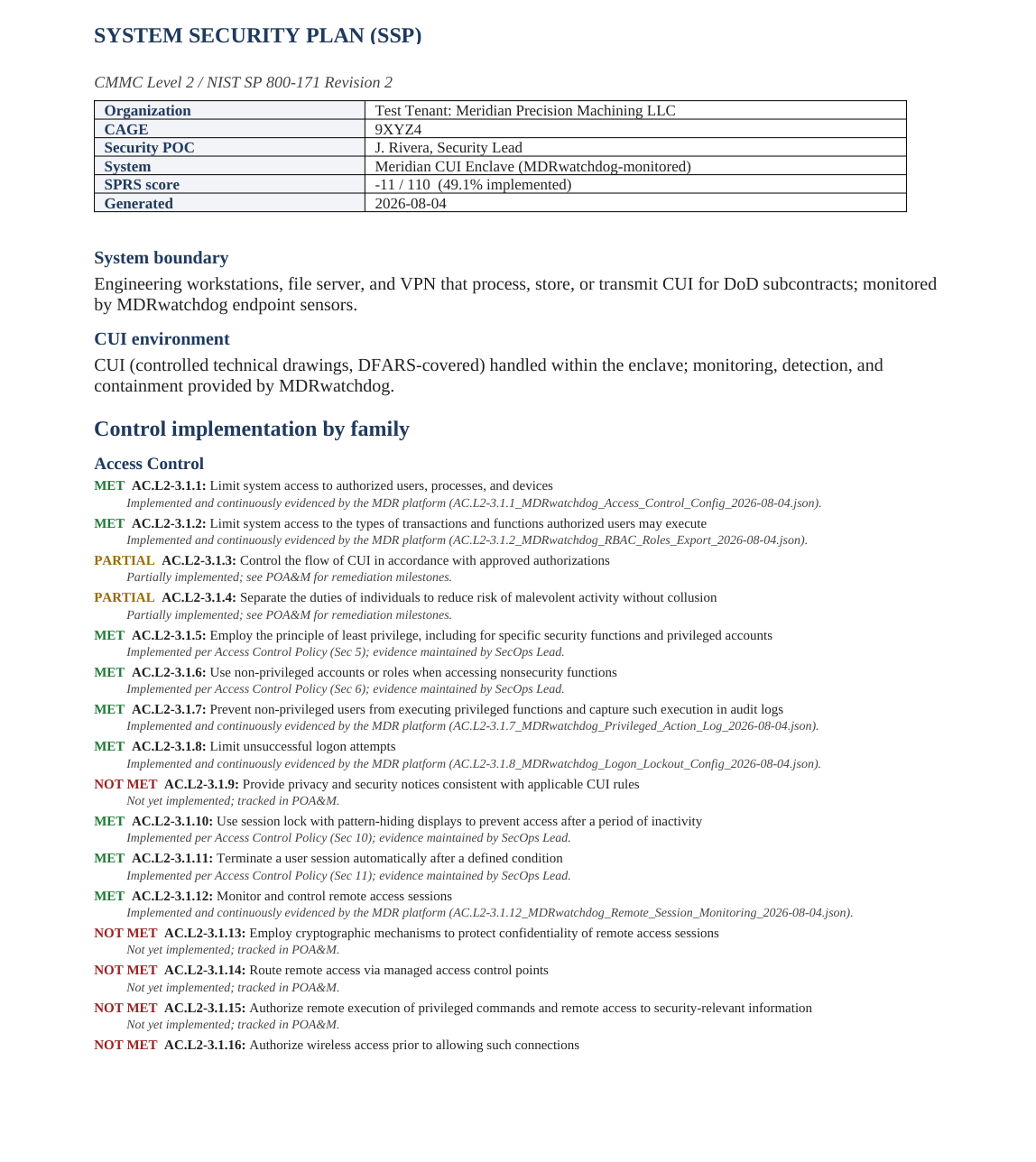
Sample outputSample System Security Plan generated by MDRwatchdog, showing the control matrix with controls marked as evidenced by system telemetry versus attestation-required.
A sample SSP generated by MDRwatchdog. Controls evidenced by live system telemetry are populated automatically; controls that still need a human policy sign-off are flagged.
Why the SSP matters

Five ways a living SSP pays for itself

Closes deals faster

Enterprise and government buyers won't purchase until they've evaluated your security risk—and traditional questionnaires (SIG / VSA) can stall a sale for months. A comprehensive SSP presented during procurement is a trust accelerator: it shows documented boundaries, data flows, and active controls up front, so you clear vendor review faster than competitors who can't produce one.

Protects federal contracts

For defense contractors and subcontractors pursuing CMMC, an SSP is a non-negotiable requirement under NIST SP 800-171. Without one, your business is disqualified from bidding on or holding contracts that involve Controlled Unclassified Information (CUI). MDRwatchdog maps your telemetry straight to the control matrix, so the SSP you take into a C3PAO assessment is backed by real system evidence.

Cuts consulting cost

Compliance firms typically charge $10,000–$30,000 to interview staff, map systems, and draft an initial SSP by hand—and it goes stale the moment your tech stack changes, requiring another paid engagement. MDRwatchdog's pipeline keeps the control matrix fed from live telemetry, marking which items are actively evidenced by system logs versus which need a policy sign-off, so the document maintains itself instead of billing you again.

Supports better insurance terms

Cyber carriers no longer approve coverage on self-attestation alone—they demand proof. A verified SSP demonstrates the mature, structured risk management underwriters look for: concrete evidence that controls like endpoint isolation and identity monitoring are in place. It won't guarantee a number, but it's exactly the documentation that supports better terms and helps avoid denials or restrictive limits.

Shrinks your incident blast radius

An SSP forces you to map every system boundary, data-storage location, and privilege level—the exact context responders otherwise waste critical hours reconstructing mid-attack. When an incident fires on the MDRwatchdog console, that map is already there: analysts see the affected environment immediately and can authorize containment before the threat crosses a data boundary.

Evidenced vs. attestation-required — the honest split

Instead of asking you to write descriptions of how you hope your security works, MDRwatchdog sorts every control into two clear buckets—so you always know exactly what’s proven by the system and what still needs your sign-off.

Evidenced controls

Populated automatically by the platform’s sensor and detection engine—for example, controls backed by endpoint telemetry, kernel-level tracing, decoy canary files, or identity monitoring. These carry named, timestamped artifacts an assessor can verify.

Attestation-required controls

The human and corporate policies a system can’t prove on its own—employee onboarding, access reviews, physical security. MDRwatchdog flags each one, giving you a clear, step-by-step roadmap to total compliance instead of a vague to-do list.

See the readiness packages

What an SSP is, honestly. An SSP supports compliance readiness\u2014it is not a certification and not legal advice. Certification and formal audits are performed by the appropriate authorized bodies: a C3PAO for CMMC, a licensed CPA firm for SOC 2, an accredited body for ISO 27001. What MDRwatchdog does is make that assessment easier by keeping the evidence assembled and current—so you walk in with a plan backed by real system data, not a blank binder.

Related reading

Plain-language answers to the questions buyers ask most—readiness and evidence, not certification or legal advice.

Common questions

What is an SSP, and do I need one?+

A System Security Plan documents your system boundary, data flows, and the security controls protecting them. If you handle Controlled Unclassified Information as a defense contractor, an SSP is a legal requirement under NIST SP 800-171 and CMMC—you cannot hold those contracts without one. More broadly, any business handling regulated data (HIPAA, SOC 2, ISO 27001) benefits from an SSP as the backbone of its compliance program and its answer to customer security reviews.

How is an automated SSP different from one a consultant writes?+

A consultant interviews your staff and drafts a description of how your security is supposed to work—a static document that's obsolete the next time your stack changes. MDRwatchdog feeds the control matrix from live telemetry, so controls that are actually evidenced by system logs are populated automatically and stay current, while the human/policy controls that still need sign-off are flagged. It's a living blueprint, not a binder on a shelf.

Does having an SSP make me compliant or certified?+

No—and we're careful to say so. An SSP is the plan and the evidence behind it; it supports readiness, but it is not a certification and not legal advice. Formal certification is performed by the appropriate authorized body: a C3PAO for CMMC, a licensed CPA firm for SOC 2, an accredited body for ISO 27001. What MDRwatchdog does is make that assessment far easier by having the evidence assembled and current before the assessor arrives.

Can I use the SSP for vendor security reviews and cyber insurance?+

Yes—those are two of its highest-value everyday uses. Handing a prospect or an underwriter a current SSP shows a documented, evidenced security posture, which shortens vendor questionnaires and demonstrates the risk maturity carriers want to see. It supports faster reviews and better terms; it doesn't guarantee a specific outcome, and we won't claim it does.

Turn your monitoring into an audit-ready SSP.

Book a 15-minute review and we'll show you which controls your environment can already evidence—and what's left to attest.

Schedule your 15-minute review