Your remediation roadmap, generated and prioritized
Every SSP has gaps—the POA&M is how you account for them. CMMC and NIST SP 800-171 require a Plan of Action & Milestones alongside your SSP: every unmet control, with a plan and a target date. MDRwatchdog generates it from your real control posture, ranks each gap by the scoring weight that actually moves your SPRS number, and flags which controls can’t be deferred—so it’s a working roadmap, not a spreadsheet you maintain by hand.
Sample output
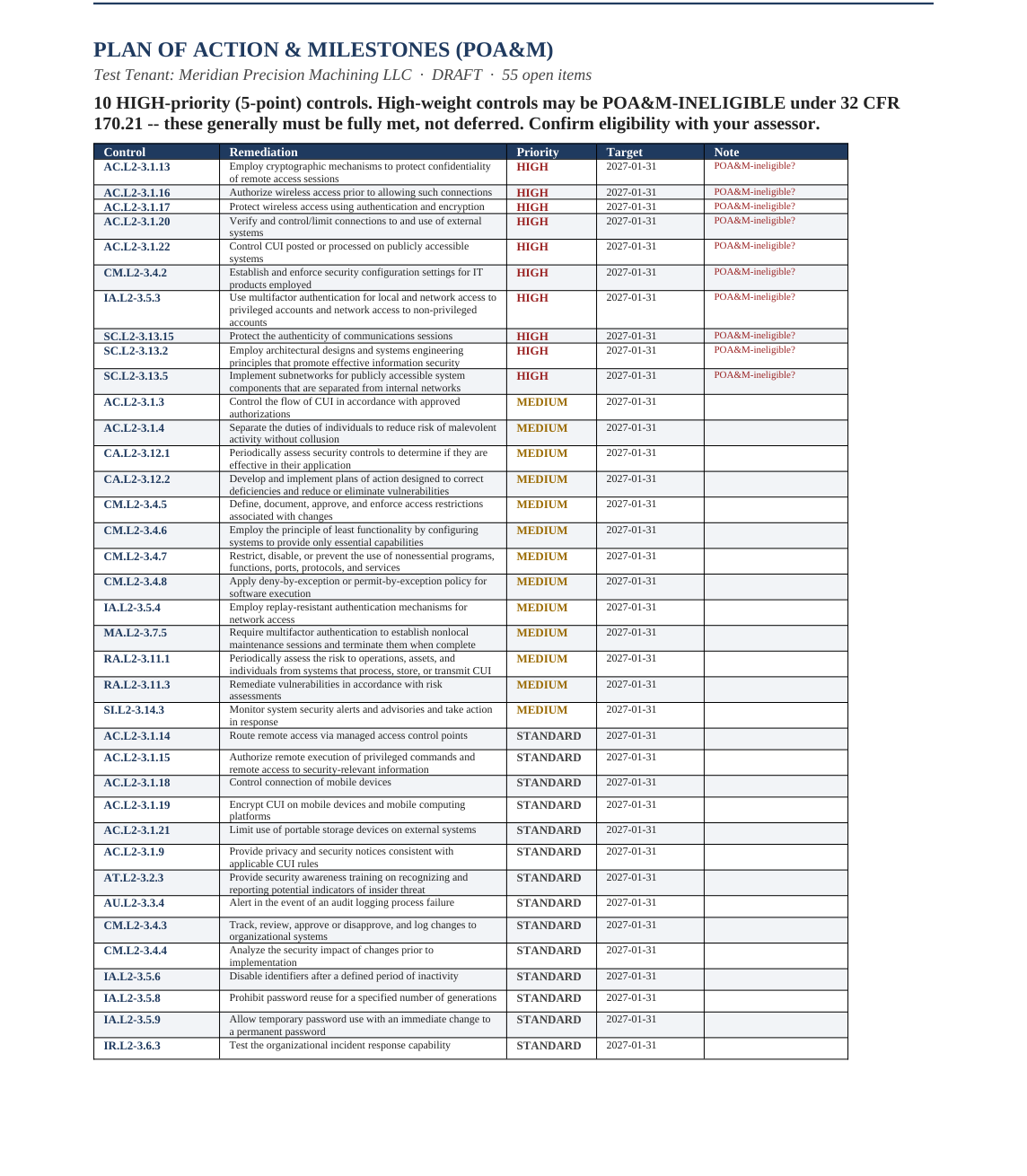
A sample POA&M generated by MDRwatchdog. Each unmet control is ranked by scoring weight, flagged for POA&M eligibility under 32 CFR 170.21, and given a target date.
Why it’s different
A roadmap that knows what to fix first
Weight-prioritized, not alphabetical
Every unmet or partial control is ranked by its actual DoD scoring weight—the 5-point controls that drag your SPRS score down most appear first, so remediation effort goes where it moves the number. A flat checklist can't tell you what to fix first; a weighted roadmap can.
POA&M-eligibility flagged
Not every gap can be deferred. High-weight controls may be POA&M-ineligible under 32 CFR 170.21—they generally must be fully met, not scheduled for later. The platform flags those rows so you don't build a remediation plan on controls an assessor won't accept as deferred.
Tied to your SPRS score
The POA&M is generated from the same assessment that produces your SPRS self-assessment score. As you close items, the score improves directly—so the roadmap doubles as a forecast of where your score goes as each control is met.
Every gap, with a target
Each unmet or partial control carries its requirement, priority, and a target date—the structure an assessor expects and the DoD's 180-day POA&M window assumes. It's a working remediation plan, not a list you still have to build.
Part of the readiness package, not a one-off
Your POA&M is generated together with the rest of your CMMC readiness set—the SSP, the full control matrix, and the SPRS self-assessment score—from one monitored environment. Close a POA&M item and the change flows through: the control matrix updates, and your SPRS score improves. One source of truth, not four documents drifting out of sync.
What a POA&M is, honestly. A POA&M is a plan to reach compliance—not compliance itself, and not legal advice. It’s a draft artifact your organization reviews, completes, and signs. Platform-evidenced controls are backed by live monitoring data; the rest need your policy, procedure, and artifacts. CMMC Level 2 certification is issued only by an authorized C3PAO, and final POA&M eligibility is confirmed with your assessor.
Related reading
Plain-language answers to the questions buyers ask most—readiness and evidence, not certification or legal advice.
A Plan of Action & Milestones is the remediation roadmap that accompanies your SSP: it lists every security control you haven't fully met, with a plan and target date to close each one. Under CMMC and NIST SP 800-171, a POA&M is how you account for gaps—the DoD allows certain controls to be scheduled for remediation within a 180-day window rather than blocking your assessment outright. Without a POA&M, unmet controls have no documented path to closure.
Which controls can actually go on a POA&M?+
Not all of them. Under 32 CFR 170.21, high-weight controls are generally POA&M-ineligible—they must be fully implemented, not deferred. Lower-weight gaps can typically be scheduled. MDRwatchdog flags the high-weight, potentially-ineligible controls directly in the POA&M so you don't plan around a deferral your assessor won't accept. Confirm final eligibility with your C3PAO.
How is this different from a POA&M spreadsheet I maintain myself?+
A hand-maintained spreadsheet is a static snapshot that goes stale the moment your posture changes, and it doesn't know which gaps hurt your score most. MDRwatchdog generates the POA&M from your live control assessment—ranked by scoring weight, flagged for eligibility, and regenerated as your posture changes—so the roadmap stays current and always points at the highest-impact work first.
Does the POA&M make me compliant?+
No. A POA&M is a plan to reach compliance, not compliance itself, and it is not legal advice. It documents your gaps and your path to closing them—valuable for an assessment and required by the framework—but certification is issued only by an authorized C3PAO for CMMC. The POA&M is a draft artifact your organization reviews, completes, and owns.
Turn your gaps into a prioritized plan.
Book a 15-minute review and we'll show you the POA&M your environment generates—ranked by what moves your score first.